
You’ve probably spent the last year watching your inbox fill up with “must-have” tools that promise to do your job in half the time. Your company has likely invested a small fortune in licenses, pilots, and training sessions. But if you’re honest, you haven’t seen the payoff yet. Your team is still working late, projects are still lagging, and the promised efficiency feels like a mirage.
You aren’t alone. Deloitte just released their 2026 Human Capital Trends report, and it’s a wake-up call for tech optimists. They found that while everyone is rushing to buy the latest technology, only about 6 percent of leaders feel they’ve truly figured out how to make humans and AI work together. Even more telling, 65 percent of organizations realize their culture needs a complete overhaul to handle this shift.
This isn’t a software problem. It’s a cultural challenge. We’re trying to fit twenty-first-century intelligence into a twentieth-century operating system. We’ve built cultures around control, perfection, and linear processes, but AI thrives on experimentation, iteration, and probabilistic thinking. If you don’t close the gap between how your people think and how the machines operate, you’re just buying expensive toys that nobody knows how to play with. We’ll discuss how to stop chasing after the tech and start building a culture that makes it actually work.
The Accumulation of Cultural Debt
Think about the last time you ignored a small leak in your house. You thought it wasn’t a big deal, so you placed a bucket under it and moved on. But over time, that water seeped into the floorboards, rotted the wood, and eventually cost you ten times more to fix than if you had just addressed it on day one. That’s exactly what’s happening with your company culture right now.
Deloitte calls this “Cultural Debt.” It’s the hidden cost of unresolved issues we’ve pushed aside while chasing the next big thing. We’ve ignored poor communication, tolerated a lack of trust, and let psychological safety decline because we were too busy launching new products or, lately, “transforming” with AI. We assumed the technology would fix the problems, but it actually made them worse.
When you introduce AI into a low-trust environment, people don’t see it as a teammate. They see it as a threat. They hide their work, feed the machine bad data to protect their jobs, or they simply ignore the tool altogether. The debt begins accruing interest. Every failed pilot and every ignored prompt signals that your foundation is deteriorating. You can’t build a high-speed future on a foundation of hidden fears and outdated habits. Before you purchase another seat of Copilot, you need to pay down that debt by honestly assessing where your team is truly struggling.
Redesigning the Human-AI Interaction
Imagine you’re hiring a talented new employee. You wouldn’t just give them a laptop and say “figure it out.” You’d define their role, set expectations, and clarify how they interact with the rest of the team. Yet, that’s exactly how we’re treating AI. We dump the tool on the desk and hope for the best.
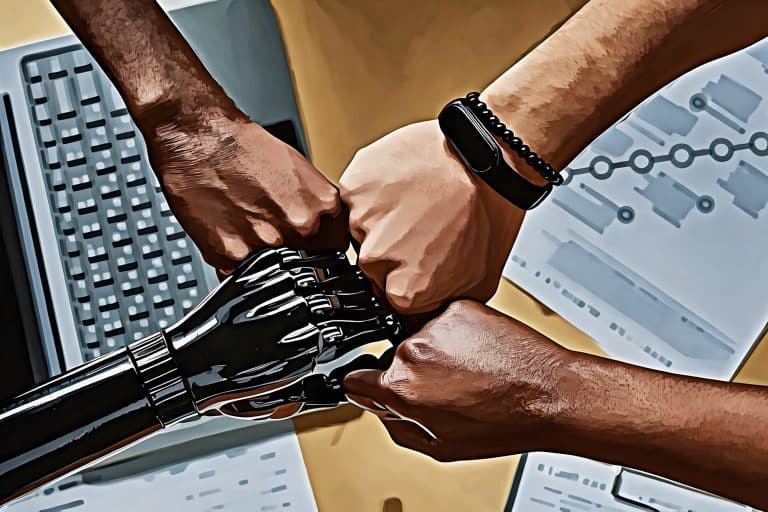
The real winners in the AI race won’t be those with the fastest models. They’ll be the ones who have designed the “handshake” between the person and the process. This means shifting away from the idea of “automation,” where the machine replaces the human, and moving toward “convergence,” where the machine amplifies the human. Only 6 percent of leaders are making progress here because it’s challenging. It requires examining every workflow and asking: “Where does the human judgment stop and the machine processing begin?”
This redesign isn’t a one-and-done project. It’s an ongoing conversation. You need to establish “feedback loops” where your team can openly discuss what the AI gets right and, more importantly, what it gets wrong. If your culture punishes people for admitting mistakes, they’ll never tell you when AI hallucinations are steering the project off course. You have to reward skeptics just as much as early adopters. The goal is a team that knows exactly when to trust the tool and when to take the wheel back.
From Control to Orchestration
If your management style relies on knowing every detail of your team’s work, AI is about to make things difficult for you. The pace at which work now moves means you can’t be the bottleneck anymore. You can’t review every draft, approve every line of code, or sign off on every data point. If you try, you’ll just slow down the entire process.
We’re transitioning from an era of “management by oversight” to “leadership by orchestration.” Picture yourself less as a supervisor and more as a conductor. You’re not playing the instruments; you’re making sure everyone plays the same song at the same tempo. You’re setting the goal—the “why” and the “what”—and allowing the team (and their AI assistants) to figure out the “how.”
This shift requires a level of trust that most managers find intimidating. It involves letting go of control and trusting that your team shares your values and understands the objectives. It means prioritizing outcomes over activities. If the project is completed perfectly and on time, it shouldn’t matter if the human spent four hours on it or if the AI did it in four minutes while the human used that time to think about the next big strategy. You have to stop tracking the clock and start focusing on the impact.
The End of Performative Busywork
Let’s be honest: much of what we do in the office is just theater. We write long emails to appear busy, join meetings to be seen, and spend hours on slide decks that no one reads. We’ve long equated “busy” with “productive” and don’t know how to stop. But AI is the ultimate BS detector. It can summarize that ten-page memo into three bullet points, making all that effort seem like a total waste of time.
This is causing a small identity crisis for middle managers. If the machine can handle reporting, scheduling, and summarizing, what’s left for us? The answer is the stuff that truly matters: empathy, intuition, and complex problem-solving. But to get there, you have to let go of performative work.
You need to give your team permission to do less “work” and more “thinking.” This is a major cultural shift. It means valuing a person who sits staring out the window for an hour if they come up with a solution that saves the project. It means stopping the reward for the longest email or the most meetings attended. We must redefine what a “good day” looks like. In the AI era, a good day is one where you use your human edge to make progress, not just navigate bureaucracy.
Building Cognitive Resilience
The pace of work now is faster than anything we’ve experienced before. The sheer volume of information generated by AI is overwhelming our teams. We’re in a state of “cognitive shallow-breathing,’ constantly reacting to pings, summaries, and notifications without having the chance to breathe and think deeply.
As a leader, your role is to safeguard your team’s mental energy. This is a strategic necessity, not just a wellness program. If your team is constantly pushed to their limits, their judgment will suffer. They’ll begin making small errors that can escalate into major problems. You need to create “quiet zones” within the workday.
Try a “No-Meeting Wednesday” or a “Deep-Work Morning” where all communication tools are turned off. Show your team that you value their focus more than their responsiveness. If you’re the one sending urgent Slack messages on a Saturday night, you’re the problem. You’re signaling that the machine never stops, so they shouldn’t either. But humans aren’t machines. We need downtime to stay sharp. The leaders who win in the next decade will be the ones who manage their team’s energy as carefully as they manage their budget.
The Transparency Imperative
A growing trust gap is emerging in the workplace. Employees observe AI progress and worry about when the other shoe will drop. They see the executive “transformation” talk as signals that “layoffs are coming.” If you don’t address those fears head-on, your culture could become stagnant.
Authentic leadership now means being completely transparent about the roadmap. You need to share what you know, what you don’t know, and what you’re still figuring out. If you’re testing a tool that could change someone’s role, tell them now, not three months later. Involve them in the testing process. Let them be the ones to tell you how their job should evolve.
Trust is the only currency that scales in a fast-paced environment. You can’t create a policy for every AI interaction. You have to trust that your team will use the tools ethically and effectively. But they’ll only do that if they believe you have their back. You need to shift from a culture of “monitoring” to a culture of “mentoring.” Stop focusing on keystrokes and start focusing on growth. When your team feels safe, they’ll reveal the true potential of what they can accomplish with a little help from the machine.
Choosing the Human Advantage
We’re at a tipping point. You can either use AI to try and squeeze a little more efficiency out of an old, broken culture, or you can use it as a catalyst to build something better. The organizations that thrive in the next decade won’t be the ones with the most advanced tech. They’ll be the ones who have figured out how to be more human.
They’ll be the ones who valued trust over control, focus over activity, and judgment over processing. They’ll be the ones who paid down their cultural debt and redesigned their work around the human advantage. The tech is just the tool. You are the architect.
So, take one last sip of that coffee and reflect on your team. Are you clearing the way for them, or are you the one holding them back? The machine is ready. The question is, is your culture?