
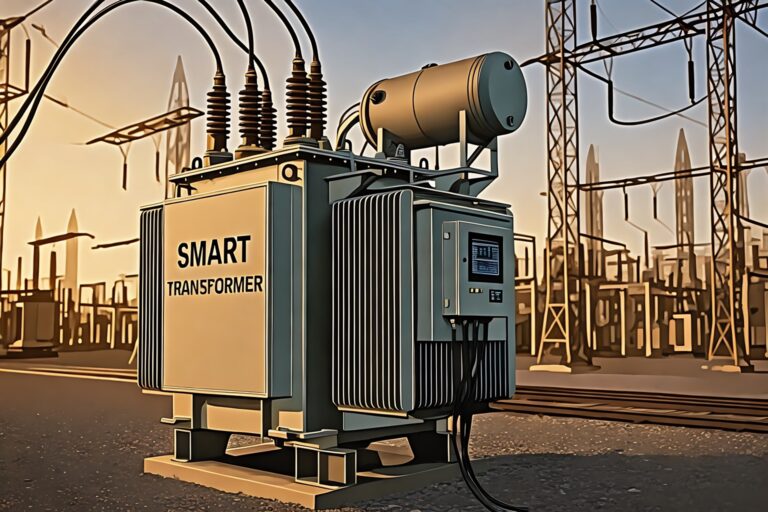
Transformers have traditionally been quiet workhorses of the electric system, stepping voltage up and down while rarely attracting attention unless something malfunctions. That era is coming to an end. Rising electrification, faster deployment of inverter-based resources, expanding electric vehicle charging, and climate-driven extremes are prompting utilities to view transformers not just as passive iron, but as intelligent, networked assets. “Smart transformers” are now emerging: instrumented devices with built-in sensors, edge computing, secure communications, and software that convert raw data into operational decisions. They facilitate two-way power flows, support grid-forming functions at the distribution edge, and enable operators to actively manage loading and asset health rather than relying solely on static nameplates. This shift is essential. Lead times for large power transformers remain lengthy, fleets are aging, and the installed transformer capacity in distribution systems must increase significantly to handle new loads. In that context, extracting more lifespan, flexibility, and visibility from every installed unit is becoming a strategic priority rather than just an optional technology advancement.
What a Smart Transformer Is—and What It Is Not
A smart transformer is, first and foremost, a transformer. The core electromagnetic functions—galvanic isolation and voltage conversion—remain the same. What’s new is an integrated “digital layer” that equips the asset with sensors for temperature, oil level, moisture, current, and vibration; adds online dissolved-gas analysis and bushing monitors; embeds an on-load tap changer controller with analytics; and connects everything via secure gateways to on-premises or cloud analytics. Leading platforms provide data through open interfaces and incorporate cybersecurity by design, rather than adding it as an afterthought. Practically, this means operators can see actual hot-spot temperatures, identify early faults and partial discharges, link tap-changer operations with power-quality events, and intervene before small issues grow. This isn’t just theory: major OEMs now deliver transformers that are “born digital,” with secure setup and device-to-cloud authentication built in.
It is equally important to define what smart transformers are not. They are not, by default, power-electronic solid-state transformers (SSTs). Most smart units today are conventional oil-immersed or dry-type machines that are enhanced with sensors, communications, and control systems. SSTs—essentially multiport converters with medium-frequency isolation—are emerging and will be relevant in certain applications, but they are not yet the standard in the field. Clarifying this distinction helps prevent inflated expectations regarding fast dynamic voltage regulation or embedded reactive-power control, which only some devices can currently provide.
Why Utilities Are Deploying Smart Transformers Now
The business case relies on converging drivers. Distribution transformer fleets are large, aging, and under strain. Analyses from the National Renewable Energy Laboratory (NREL) estimate that the U.S. stock of in-service distribution transformers is in the tens of millions, and that installed distribution-transformer capacity may need to grow significantly by mid-century to meet electrification scenarios. These growth needs contribute to replacement requirements resulting from age-related failures and extreme weather conditions. At the same time, the broader supply chain for both distribution units and large power transformers remains limited, prompting federal agencies to prioritize resilience and fund advanced components to reduce systemic risk.
Regulatory and policy trends reinforce this movement. The Department of Energy’s proposed updates to distribution-transformer efficiency standards have heightened focus on materials, losses, and life-cycle costs, while grid-modernization strategies prioritize digital capabilities and IT/OT integration over merely physical capacity expansion. The message is clear: utilities are now expected to buy not just copper and steel, but also intelligence, interoperability, and cyber-secure designs that provide measurable operational value.
How Smart Transformers Create Operational Value
The first and most tangible value stream is condition-based maintenance. Online dissolved-gas analysis provides an early warning of thermal faults, partial discharges, and arcing that offline oil sampling may miss between maintenance cycles. Continuous bushing-health monitoring detects rapid changes in capacitance or power factor that have historically preceded catastrophic bushing failures. Fiber-optic probes and advanced thermal models convert loading and ambient conditions into actual hot-spot temperatures, enabling operators to avoid unnecessary conservatism—or to recognize when apparent headroom is illusory due to accelerated insulation aging. These capabilities shift maintenance from interval-based to needs-based, reduce forced outages, and extend useful life by keeping operation within measured, not assumed, limits.
A second value stream is dynamic loading. Traditional loading guides are inherently static approximations; they must generalize across designs, cooling classes, climates, and maintenance histories. Smart transformers implement IEC-aligned dynamic thermal models driven by real-time measurements, allowing operators to safely increase capacity during peak events and reduce it when thermal margins become tight. In renewable-rich corridors, dynamic loading enables short-term overloading to ride through cloud transients or wind ramps without exceeding insulation-life limits. In practice, this approach can delay capital upgrades and help smooth ramping requirements on adjacent equipment.
A third value stream focuses on power quality and voltage management. Utilizing secure communication with advanced distribution management systems, smart transformers enable and implement conservation voltage reduction and voltage/VAR optimization strategies. They coordinate with regulators, capacitor banks, and smart inverters to keep voltage within ANSI limits while reducing losses. Real-time data on tap-changer positions and actions, along with event logs and oscillography, offers visibility that dispatchers and planners can use to identify weak feeders or problematic DER clusters. In a system with millions of behind-the-meter inverters and bidirectional vehicle chargers, visibility is essential; it is the key to safe operations rather than mere oversight.
Two-Way Power Flows and Inverter-Based Resources
Smart transformers are particularly suitable for grids that are increasingly dominated by inverter-based resources. Their sensors and analytics deliver high-resolution, time-aligned data sets needed to validate dynamic models, adjust protection settings, and investigate abnormal events. As planning agencies expand electromagnetic transient studies to accommodate high-IBR penetrations, data from instrumented transformers and related equipment becomes crucial for aligning study assumptions with actual behavior. By providing visibility at the point where voltage is delivered, smart transformers help harmonize control objectives across DERMS, ADMS, and inverter-level controls.
From Digital Iron to Power Electronics: Where Solid-State Fits
The most advanced concept of a “smart transformer” uses power electronics to replace or enhance the magnetic core. Solid-state transformers and hybrid designs incorporate controllable converters that can regulate voltage and frequency locally, improve power factor, and even provide multiport interfaces for batteries or DC loads. Research institutions have demonstrated that SSTs can provide reactive power support and offer fast dynamic responses that traditional units cannot match. Meanwhile, ARPA-E projects continue to advance the device technology, materials, and packaging needed to make these converters efficient and compact enough for medium-voltage use. In fast-charging depots, data-center campuses, and rail systems, these platforms may surpass traditional designs by naturally supporting DC loads, integrating storage, and offering ride-through and harmonic filtering as part of the transformer. Currently, SSTs are a niche product, but their future potential grows where controllability justifies the extra cost.
Cybersecurity and Interoperability by Design
Transforming transformers into IP-addressable devices introduces a new attack surface, making cybersecurity a primary concern. Modern digital platforms adopt secure device bootstrapping, certificate-based authentication, encrypted telemetry, and role-based access control. They also prioritize manufacturer-neutral data models to prevent vendor lock-in and facilitate integration into utility security operations centers and data lakes. The policy environment is crucial, as national smart-grid guidelines emphasize a cyber-physical platform approach and IT/OT convergence, reinforcing that digitalized primary equipment should meet security standards and work seamlessly with incident-response workflows. Overall, smart transformers designed with security and open interfaces from the outset can enhance situational awareness rather than compromise it.
Supply-Chain Reality and the Case for Intelligence
Utilities cannot replace their fleets overnight. Even in optimistic scenarios, expanding installed transformer capacity to support electrification will take decades, and large power transformers will continue to experience long manufacturing and logistics cycles. Federal programs focused on transformer resilience and advanced components reflect this reality by funding innovations that enhance performance and reduce vulnerabilities in design, materials, and monitoring. Given these constraints, the best strategy is to maximize the value of every unit deployed. Smart features achieve this by reducing unplanned outages, enabling more effective emergency loading during heatwaves or cold snaps, and providing data that supports targeted reinforcements instead of broad overbuilding. In short, intelligence acts as a force multiplier for limited physical capacity.
What Deployment Looks Like in Practice
Mature programs typically begin with high-criticality assets, such as large power transformers at major substations, grid-forming nodes, or sub-transmission interties. These units are equipped with extensive sensor arrays, online DGA, bushing monitors, and OLTC analytics, with data transmitted to an enterprise asset-performance platform. Insights from these sites then inform distribution programs that focus on feeders experiencing rapid load growth, high rooftop solar density, or EV fast-charging clusters, where hot-spot temperatures, harmonic content, and tap-changer duty cycles can significantly exceed historical norms. The operating approach also advances. Instead of a test team relying on offline oil lab results a few times a year, cross-functional teams utilize dashboards that link transformer health with feeder power quality, protection events, and DER telemetry. Incident management shifts from “roll a truck” to “acknowledge alert, confirm with secondary telemetry, and pre-stage a mobile unit only if thresholds continue to drift.” Over time, utilities formalize these workflows, incorporate predictive models, and compare transformer health to industry benchmarks, ensuring that capital plans are based on measured risk rather than generic age curves. Evidence from industry programs and vendor case studies consistently demonstrates earlier fault detection, fewer catastrophic failures, and more precise targeting of rebuilds and replacements when continuous monitoring is in place.
Planning and Standards: Making Smart the Default
Adoption at scale requires more than just hardware. Utilities that move fastest incorporate digital requirements into specifications, insisting on secure provisioning, standard data models, and testable acceptance criteria. They also align with enterprise data strategies, so transformer data isn’t stranded in vendor portals but ingested into analytics pipelines alongside SCADA, AMI, and PMU streams. On the planning side, as the penetration of inverter-based resources rises, smart-transformer data helps planners validate electromagnetic transient models, improve voltage control schemes, and quantify the benefits of conservation-voltage programs without overtaxing tap changers. Standards and guidance—ranging from IEC 61850 for substation communications to NERC recommended practices for EMT studies—provide a foundation for consistent deployments and model fidelity.
Where the Technology Is Headed
The near-term approach is gradual yet significant, involving the addition of more sensors, enhanced edge analytics, tighter integration with ADMS and DERMS, and the implementation of secure APIs that enable independent software to add value across diverse fleets. As utilities digitize other key equipment—such as breakers, switchgear, and capacitor banks—the transformer becomes part of a unified “digital substation,” not just an isolated pilot project. The medium-term plan involves targeted deployment of hybrid or solid-state transformers where controllability is most critical, especially at the interface with high-power DC loads or microgrids. Ultimately, as the transformer supply chain continues to expand with ongoing policy focus, standard specifications will continue to evolve. Over time, installing a large or medium-power transformer without secure telemetry and analytics will seem as outdated as installing a relay without event recording.
Conclusion
Smart transformers represent a clear yet significant shift in how the industry approaches a fundamental asset. By adding sensors and networking capabilities, utilities transform a passive device into an active one, enhancing reliability, flexibility, and safety. This shift is driven by necessity—aging equipment, supply chain issues, electrification, and the complexities of inverter-rich grids—but it offers advantages beyond just reducing risk. Smart transformers optimize thermal usage, improve maintenance, enhance power quality, and provide the detailed data required for modern planning and protection. The future potential of solid-state platforms is genuine, but the current value of digitalized machines is already tangible and worth investing in. As utilities update their specifications and capital strategies, making intelligence a standard feature rather than an optional add-on is the most straightforward and cost-effective way to build a grid that is not only larger but also demonstrably smarter.