
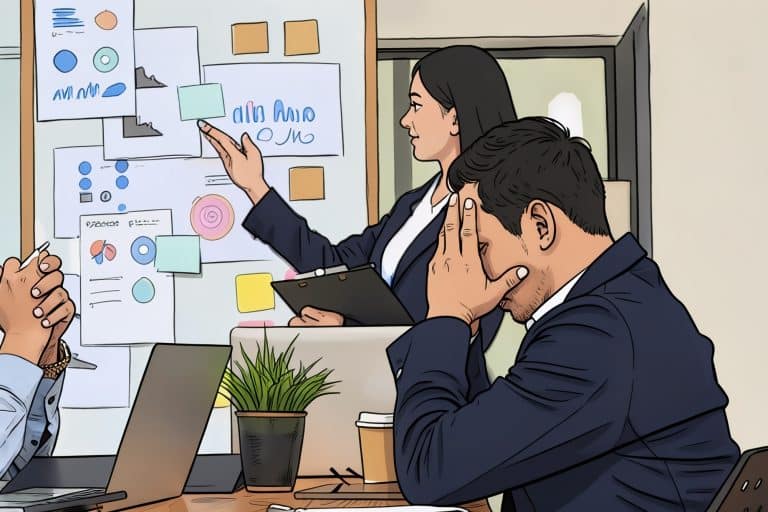
Many change efforts do not fail in a dramatic way. They wear people out.
A company launches a new reporting structure, then adjusts office expectations, then changes performance language, then installs a new tool, then resets priorities after a rough quarter. None of those moves is shocking on its own. Taken together, they can leave people feeling as though the ground never quite holds still. Work still gets done, but with more drag. Managers repeat themselves. Teams keep asking what matters now. Good employees begin to conserve energy instead of giving it freely. That is change fatigue.
This is not a soft problem. It is a management problem. When people are hit with too much change, too quickly, without enough clarity or recovery time, judgment slips. Attention narrows. Meetings multiply because no one trusts the handoff. Managers stop coaching and start patching holes. Employees stop asking whether a change is smart and start asking how long they have to survive it. At that point, change stops being a leadership tool and becomes an operating risk.
Recent workplace research gives this issue real weight. SHRM’s April 2026 coverage on organizational change fatigue argues that repeated change without sufficient recovery time is wearing people down and undermining execution. McKinsey’s 2026 State of Organizations report says sustained performance now matters more than short bursts of adaptation, a point that lands differently when many firms still run change like a series of emergency pushes. Gallup’s latest leadership analysis adds another warning: leaders are more likely than those they lead to report difficult daily emotions, even when they score higher on overall life evaluation. That tells you something important. The people carrying change are paying a price, too.
For middle managers and above, this topic matters because change fatigue usually shows up in the areas they control. It shows up in the number of priorities a team is asked to hold, the number of systems people have to learn, how often the story changes, how much context is shared, and whether there is any pause between one push and the next. If leaders want better execution, they have to stop treating fatigue as an employee weakness and start treating it as the predictable cost of poorly managed change.
How change fatigue builds
Change fatigue does not come only from the size of a change. More often, it stems from accumulation.
A single reorganization can be hard. A new performance process can be hard. A shift in office policy can be hard. A technology rollout can be hard. But when each one lands before the last has settled, people lose their footing. They stop absorbing the reasons for each move and start feeling only the disruption.
That pattern has been building for years. A widely cited Gartner finding, later discussed in Harvard Business Review, reported that the average employee experienced ten planned enterprise changes in 2022, up from two in 2016. Employee willingness to support enterprise change fell from 74 percent in 2016 to 43 percent in 2022. Those numbers matter because they reveal a basic truth leaders often miss: even useful change carries a cost. Employees are not resisting because they are lazy. Many are simply overloaded.
SHRM’s recent work frames the problem in similar terms. Its April 2026 article on organizational change fatigue argues that workers are being asked to absorb constant shifts without sufficient time to adapt, recover, or make sense of what the changes mean for the work in front of them. That fatigue then manifests as lower engagement, more resistance, and slower adoption. This is not surprising. People can stretch for a while, but not without end.
The mistake many leaders make is assuming that because the organization has changed, the workforce has changed with it. That is rarely true. A new structure can appear on an org chart in a day. It can take months for people to understand new roles, trust new reporting lines, and stop using old routes to get work done. Leaders declare the change complete too early because the visible part is finished. The human part is not.
Why middle managers feel the strain first
Middle managers usually feel change fatigue before senior leaders do, and they feel it more acutely.
They do not just have to understand the new direction. They have to translate it, defend it, and make it workable for others. They are also expected to keep results on track even as the ground shifts. It becomes harder when changes come one after another or when the reasons keep shifting.
Gallup’s April 2026 analysis of leaders with “better lives but worse days” helps explain the hidden cost. Leaders may look fine on paper. They may still report higher engagement and better overall life ratings. But they are also more likely to report stress, anger, sadness, and loneliness in daily life. That gap matters because it shows that some leaders are functioning under strain that is not apparent from performance alone. In other words, the people being asked to carry change can still look successful while running hot underneath.
This is where bad management habits tend to take root. When managers are overloaded, they shorten explanations, cancel one-on-ones, and let weak priorities pile up because they lack time to sort them. They avoid hard conversations because another change message is already waiting in the queue. As a result, employees experience management as inconsistent. Standards blur. Direction sounds provisional. Teams start waiting instead of moving.
It is also why change fatigue is often misunderstood. Senior leaders may see hesitation and conclude that teams are resistant. The middle layer often sees something different. People are tired of relearning the rules. They are tired of investing energy in something that might be replaced in two months. They are tired of being told this change is the one that will settle the system, only to be handed another one before the first is even stable.
What fatigue does to judgment and execution
Fatigue changes how people think. That is one reason it is so damaging.
Decision quality usually declines before anyone admits the team is exhausted. People stop weighing options carefully and default to whatever is fastest, safest, or least likely to draw attention. That makes sense in the short term, but it is bad for the organization over time.
SHRM’s April 28, 2026 webinar on decision fatigue made this point in plain language. The more decisions people make in a day, the more mentally and emotionally depleted they become. At work, this can be triggered by repetitive tasks, frequent corrections, and compliance-heavy processes. Put that in an organization already undergoing nonstop change, and you get a predictable result: people conserve energy by simplifying too early. They stop asking whether the process makes sense and focus only on surviving it.
McKinsey has made a related point in its research on change. For many firms, change is no longer episodic. It is becoming continuous. Continuous change means people are expected to learn, adapt, and let go of old routines repeatedly while still meeting performance targets. That can work only if leadership is disciplined about sequence, communication, and recovery. Without that discipline, “continuous change” becomes a polite phrase for chronic disruption.
The effect on execution is easy to spot once you know where to look. Work slows because people need extra confirmation. Rework rises because instructions are heard but not absorbed. Informal workarounds spread because official processes keep moving. Meetings grow because leaders no longer trust the first answer. Teams spend more time coordinating and less time finishing. None of this looks like a dramatic collapse. It looks like organizational drag. That is why it persists longer than it should.
What leaders get wrong about resilience
Many companies respond to change fatigue by talking about resilience. There is nothing wrong with resilience, but it is often used as an escape hatch.
If the real issue is that the organization keeps piling on new priorities, systems, structures, and policies without enough time or support, then asking employees to be more resilient solves very little. It shifts responsibility downward. It tells workers to absorb what leaders failed to sequence properly.
A better approach starts with a simpler question: how much change can this team actually carry out well right now? Not theoretically. Not in the strategy deck. In real-world terms.
McKinsey’s 2026 State of Organizations report pushes leaders toward sustained performance rather than short bursts of activity. That is a useful lens here. A company can force visible motion through repeated change campaigns. That does not mean it is building durable performance. In many cases, it is burning managerial attention and employee credibility to send a short-term signal of action.
The harder discipline is to choose fewer changes, stage them more carefully, and stick with them long enough for people to absorb them. That is not laziness. It is respect for how organizations actually work. A team cannot master a new operating rhythm if leaders keep yanking the metronome.
This is also where senior leaders need to stop confusing an announcement with adoption. A change is not real because it was launched. It is real when people understand it, use it, and no longer need to be reminded every hour that it exists. Until then, the organization is still in transition, whether the executive team admits it or not.
What better management looks like during heavy change
The answer is not to avoid change. The answer is to manage it as if it has a cost.
First, narrow the field. Teams should not carry six top priorities at once. If leadership says everything matters, employees hear that nothing has been decided. Real direction requires subtraction. People need to know what moved up, what moved down, and what can wait.
Second, provide context before compliance. Too many leaders announce a change and jump straight into execution steps. That is backwards. People need to know what problem the change is solving, why this approach was chosen over others, and what will be different in daily work. When that context is missing, resistance usually rises because employees are left to invent the story themselves.
Third, protect managers’ time. If the middle layer is expected to absorb and translate change, it needs room to do so. That means fewer nonessential meetings, fewer duplicate reports, and fewer process chores that add no real value.
Fourth, build in pauses on purpose. Short pauses let teams stabilize. A process that has been live for thirty days may appear active on a dashboard yet still be confusing to the people using it. Good leaders check for that. They do not just measure rollout speed. They measure whether the change has actually settled into work.
Fifth, tell the truth when something is not landing. Employees do not expect leaders to get every change right on the first try. They do expect honesty. Nothing drains energy faster than being forced to act enthusiastic about a rollout that everyone knows is clumsy. A straightforward correction earns more trust than a polished defense of what is not working.
Conclusion
Change fatigue is not a passing mood. It occurs when organizations keep demanding adaptation without respecting the limits of attention, time, and managerial capacity.
That makes it a leadership issue in the oldest sense of the word. Leaders set the pace. They decide how many priorities a team will carry. They choose whether a change will be clearly explained or dropped like a weather report. They decide whether managers will have time to coach people through the shift or whether they will be left to improvise under pressure.
For middle managers, the lesson is clear. Your role is not to make every change feel painless. It is to keep the work intelligible as the organization moves. That means cutting noise, naming trade-offs, keeping standards steady, and refusing to pretend that constant churn is the same as progress.
For senior leaders, the lesson is harder. If your organization is tired, that does not automatically mean your people lack grit. It may mean you have mistaken movement for discipline. A company can change all year and still execute worse.
The firms that handle change well are not the ones that demand endless flexibility. They are the ones that sequence change, explain it honestly, protect the managerial layer, and leave enough room for new habits to take hold. That is how change becomes useful rather than exhausting.